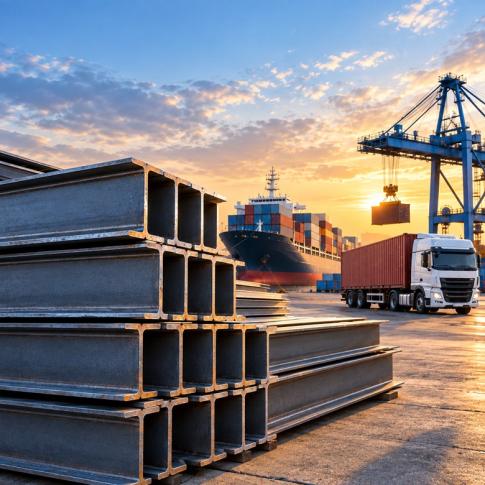
Iron beam export to neighboring countries, particularly Iraq, can create valuable opportunities for manufacturers, traders, and foreign buyers. However, success in this market does not depend solely on the product price. Factors such as beam quality, manufacturer, product standard, order volume, transportation costs, payment terms, and export regulations are also highly important.
Steel I-beams are among the most important steel sections used in the construction industry and civil engineering projects, and due to their wide range of applications, they are also in significant demand in international markets. With its considerable steel production capacity and access to regional markets, Iran is considered one of the major suppliers of steel products in the region.
Iron beam export to neighboring countries, particularly Iraq, can create valuable opportunities for manufacturers, traders, and foreign buyers. However, success in this market does not depend solely on the product price. Factors such as beam quality, manufacturer, product standard, order volume, transportation costs, payment terms, and export regulations are also highly important.
In this post by Tisa Tamin, we take a comprehensive look at the iron beam export process, the factors affecting export iron beam prices, direct purchases from manufacturers, iron beam exports to Iraq, export procedures, and the most important customs considerations.
Iron beam export refers to the sale and shipment of iron beams produced in Iran to buyers and consumers outside the country. This process can be carried out directly between the manufacturer and a foreign buyer or through trading companies and steel product suppliers.
Export iron beams are generally priced and supplied based on specifications such as:
Iron beam size
Production standard
Weight per piece
Piece length
Manufacturer
Steel grade
Order volume
Destination country
In export transactions, in addition to the technical specifications of the product, delivery and transportation terms are also highly important. For example, the quoted ex-factory price is not the same as the final delivered price at the destination, and costs such as transportation, insurance, export customs procedures, and other related expenses must be taken into account when calculating the final price.
Export iron beam sales are generally carried out for bulk orders, and foreign buyers specify the technical specifications, manufacturer, required quantity, and delivery location before placing an order.
In a professional export transaction, the product specifications and destination are first determined, and the price is then established based on current market conditions and the terms of the transaction.
Direct-from-manufacturer export iron beam sales are also an option considered by bulk buyers. This method can provide access to larger volumes and more direct coordination with the manufacturer. However, the availability of direct purchasing, minimum tonnage, payment terms, and delivery method depend on the manufacturer's policies and the nature of the order.
For foreign buyers, working with a reliable supplier can simplify the process of obtaining price quotations, checking product quality, coordinating loading, and handling export procedures.
One of the most important questions for buyers is the export iron beam price. Unlike a fixed price in the domestic market, the export price can vary depending on the transaction terms and destination.
The most important factors affecting export iron beam prices include:
Iron beam size is one of the main factors determining its price. I-beams in sizes 14, 16, 18, 20, and other sizes each have different weights and applications.
The brand and manufacturer also affect the product price. Products from different manufacturers may vary in terms of weight, standards, surface quality, and technical specifications.
Actual product weight is highly important in steel transactions. A difference in the weight of each piece can have a significant impact on the total value of a transaction involving several hundred tons.
Global steel market conditions and supply and demand can affect the export prices of Iranian steel products.
Since export transactions are generally conducted in international currencies, exchange rates also play an important role in determining the final price.
The distance from the manufacturer to the border, transportation method, final destination, and route conditions are important factors in calculating the total export cost.
The price of a small order may differ from that of a bulk shipment. Purchase volume, the number of trucks, or the required cargo quantity can influence commercial negotiations.
Therefore, if you are looking for an export iron beam price, it is better to request a quotation based on the exact product specifications, order volume, and destination.
The phrase direct-from-manufacturer export iron beam price is an important search term for bulk buyers. Direct purchasing can simplify the procurement process under suitable conditions; however, the "factory price" does not necessarily represent the final delivered price in the destination country.
For example, in an export order, the following items should be considered alongside the base product price:
Ex-factory price
Loading costs
Transportation costs to the customs office or border
Export customs clearance costs
Insurance, if agreed upon
International or cross-border transportation costs
Destination costs
Payment terms
Delivery terms
Therefore, when comparing prices from two suppliers, do not compare only the price per ton; instead, consider the complete terms of the transaction.
Contact our experts for the latest price quotation
The Iraqi market is one of the important regional markets for Iranian steel products. Due to its geographical proximity, land transportation from Iran to many parts of Iraq is possible.
The price of 14-size iron beam in Iraq depends on various factors, and it is not possible to provide a single fixed price.
Some of the main factors include:
Iron beam manufacturer
Weight per piece
Product standard
Number of pieces or order tonnage
Loading location in Iran
Exit border
Destination in Iraq
Transportation costs
Exchange rate
Iraqi market conditions
Tariffs and import costs at the destination
For example, the final delivered cost of an iron beam in the Kurdistan Region of Iraq may differ from the cost of delivering the same product to Baghdad or southern regions of Iraq.
Therefore, instead of searching only for the price of 14-size iron beam in Iraq, Iraqi buyers should request a complete quotation based on the destination and delivery terms.
Due to infrastructure development, construction activities, civil engineering projects, and its proximity to Iran, Iraq is one of the important export markets for Iranian steel products.
When exporting iron beams to Iraq, selecting an appropriate transportation route is highly important. Depending on the destination, commercial conditions, and border crossing used, land transportation can be carried out through different routes.
Some of the most important factors that should be determined before exporting to Iraq include:
Iron beam type and size
Product standard
Required tonnage
Manufacturer
Delivery location in Iraq
Exit border
Truck type and transportation method
Payment terms
Required documents
Responsibility for the costs of each stage
Therefore, before finalizing the contract, both the seller and buyer should clearly define responsibility for each cost and stage of the transaction.
Iron beam export is a multi-stage process, and to prevent delays or additional costs, each stage should be carefully planned from the beginning.
First, the destination country and final customer must be identified. The type of iron beam required, size, standard, purchase quantity, and delivery location are also determined at this stage.
Once the order specifications have been determined, the iron beam price is requested from the manufacturer or supplier.
At this stage, it is preferable for the price to be quoted based on a clearly defined unit, usually per ton, and for the included costs to be clearly specified.
After the initial agreement, a proforma invoice is issued containing the product specifications, quantity, price, payment terms, destination, and delivery terms.
For bulk export orders, the contract should clearly specify the details of the transaction, including:
Exact product specifications
Order quantity
Price
Transaction currency
Payment terms
Delivery schedule
Delivery location
Transportation responsibility
Inspection terms
Required documents
Once the order is finalized, the iron beams are prepared for loading according to the agreed specifications.
At this stage, checking the weight, quantity, product specifications, and related documents is highly important.
Once the cargo is ready, transportation arrangements are made. The transportation method depends on the destination and contract terms.
The goods must be declared in accordance with the applicable export regulations. The exporter or their representative submits the cargo information, documents, and declaration details.
Customs authorities review the submitted documents and information, and the necessary inspection and export clearance procedures are carried out.
Depending on the type of transaction and destination, the required documents are prepared and provided to the buyer. One of the important documents in international trade is the certificate of origin, which identifies the country where the goods were produced.
After completing the necessary formalities, the shipment leaves the country and is transported to the destination according to the terms of the contract.
One of the most important points for exporters is that steel product export regulations are not permanent and may change based on trade policies, domestic market conditions, regulations issued by the Ministry of Industry, Mine and Trade, and customs decisions.
Iron beams are classified as long steel products, and in regulations governing steel product exports, they are considered alongside products such as rebar, angles, and channels.
In previous years, various directives have also been issued concerning the regulation of long steel product exports, authorized exporters, and export customs procedures. Therefore, relying on an old directive without checking the current regulations may create problems during the export process.
For this reason, the following items should be reviewed before every export order:
The latest product export regulations
Whether the product is currently eligible for export
The product's tariff code
Customs requirements
Ministry of Industry, Mine and Trade regulations
Requirements applicable to the exporter
Required documents
Foreign exchange regulations and related obligations
Regulations of the destination country
Important note: Export regulations may change; therefore, the information in this section should not replace checking the latest customs and trade regulations at the time of the transaction.
The required documents may vary depending on the type of transaction, exporter, destination country, and current regulations. However, commercial and transportation documents are generally required in the export process.
Documents that may be used during the export process include:
Proforma invoice
Commercial invoice
Sales contract
Export declaration
Shipping documents
Certificate of origin
Documents related to product specifications
Exporter-related documents
Documents required by the destination country
The product's tariff code or HS Code must also be determined accurately, as errors in declaring product specifications and tariff codes can cause problems during the customs process.
One of the most important differences between domestic and export markets is the greater attention foreign buyers generally pay to product standards and technical specifications.
Before selling export iron beams, it should be determined which standard is required by the buyer.
The following information may be considered as part of the order:
Production standard
Steel grade
Iron beam weight
Dimensions and tolerances
Piece length
Manufacturer's technical specifications
Quality certificate or product analysis certificate
Therefore, simply describing a product as an "export iron beam" is not sufficient for a transaction, and the product's technical specifications should be accurately stated in the proforma invoice and contract.
It is not possible to identify one specific size as the best iron beam for all export markets.
The appropriate size depends on the product application and the requirements of the destination market.
For example, 14-size iron beams are widely used in certain projects and may have suitable demand in markets such as Iraq. However, this does not mean that they are suitable for every order.
Before purchasing, it is better to consider the following:
Project type + required standard + size + weight + order volume + destination market
This combination determines which product is more suitable for export.
In terms of the nature of the product, an export iron beam is not necessarily different from an iron beam available in the domestic market. The main differences may relate to the specifications requested by the customer, the agreed standard, documentation, packaging, delivery terms, and destination-country requirements.
In an export transaction, buyers generally request more detailed information about the product and transaction terms.
Therefore, when selling export iron beams, it should be determined from the beginning for which market the product is being supplied and according to which specifications.
In bulk steel transactions, even a small difference in weight, quality, or transportation costs can have a significant impact on the total value of the order.
A reliable supplier should be able to provide transparent information about the following:
Manufacturer
Product specifications
Weight and cargo quantity
Price
Preparation time
Loading location
Payment terms
Transportation terms
Export documents
Transparency in these areas helps buyers calculate the actual cost of the transaction more accurately and avoid potential disputes later.
With its activities in the supply and distribution of steel products, Tisa Tamin provides buyers and market participants with the opportunity to source and arrange export iron beam orders.
For export orders, the buyer's requirements, including iron beam size, order quantity, preferred manufacturer, and destination country, are reviewed, and the price is quoted based on current market conditions and order specifications.
To obtain a direct-from-manufacturer export iron beam price or to assess the possibility of supplying a bulk order, it is recommended to provide the exact product specifications and destination when requesting a quotation.
This helps provide a more accurate quotation and allows transportation and export costs to be calculated more effectively.
Conclusion
Iron beam export is an important part of Iran's steel product trade in regional markets. Iran's proximity to countries such as Iraq, its steel production capacity, and its land transportation network provide favorable conditions for exporting steel sections.
However, success in an export transaction does not depend solely on finding the lowest price. Choosing the right product, checking the applicable standards, identifying the manufacturer, accurately calculating transportation costs, understanding customs procedures, and reviewing the latest export regulations are all highly important.
The export iron beam price should also be calculated based on size, weight, manufacturer, order quantity, destination, and delivery terms. Therefore, a price quoted for one order cannot necessarily be applied to another order.
If you are looking to buy or sell export iron beams, export iron beams to Iraq, or purchase iron beams directly from a manufacturer, determine the complete product specifications and destination before finalizing the transaction and request a final quotation based on the actual terms of the order.
The price of export iron beams is not fixed and is determined based on size, manufacturer, weight, order volume, exchange rate, market conditions, destination, and transportation costs. To receive an accurate price, the order specifications and destination must be specified.
The price of 14-size iron beam in Iraq depends on the purchase price in Iran, manufacturer, weight, transportation costs, exit border, final destination in Iraq, and other related expenses. Therefore, the destination and delivery terms must be specified to provide an accurate quotation.
For many bulk orders, direct or near-manufacturer sourcing may be possible. However, purchasing conditions, minimum tonnage, and delivery methods depend on the manufacturer and the type of order.
In general, the export process includes receiving the order, determining product specifications, requesting a price quotation, issuing a proforma invoice, signing the contract, preparing the goods, transportation, customs declaration, completing export formalities, obtaining the required documents, and shipping the goods to the destination country.
The exact documents depend on the type of transaction and destination country. However, commercial documents, export declarations, shipping documents, invoices, and certificates of origin are among the documents commonly used in the export process.
Yes. Regulations governing steel product exports and customs requirements may change. Therefore, the latest applicable regulations and directives should be reviewed before carrying out any transaction.

Tisa Trading Group, with a history of more than 10 years, is one of the largest suppliers of graphite electrodes for the steelmaking industry in the country. This company, relying on foreign investment, has provided various types of graphite electrodes in the sizes required by Iranian industries.
Copyright © Tisa Tamin 2025. All rights reserved.
 فا
فا
 Ar
Ar