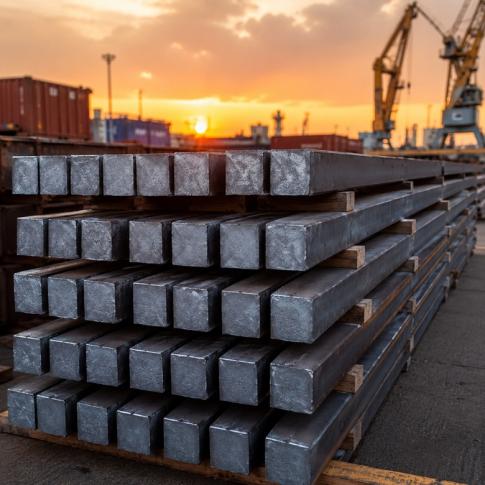
The export of steel billet is one of the important sectors of Iran's trade in semi-finished steel products. Billet, or steel billet, is considered one of the intermediate products in the steel value chain and is used as a raw material for producing various long steel products such as rebar, wire rod, different sections, and some other steel products.
The export of steel billet is one of the important sectors of Iran's trade in semi-finished steel products. Billet, or steel billet, is considered one of the intermediate products in the steel value chain and is used as a raw material for producing various long steel products such as rebar, wire rod, different sections, and some other steel products.
Iran has considerable potential for steel billet exports due to its significant steel production capacity, access to raw materials, and favorable geographical position in the region. Proximity to markets such as Iraq, Turkey, the Persian Gulf countries, and Central Asia can also be an important advantage for exporting this product.
However, exporting steel billet is not limited to finding a foreign buyer. Technical specifications and steel grade, global prices, order volume, export conditions, transportation costs, customs regulations, payment terms, and the requirements of the destination country all play a role in the success of an export transaction.
In this article, we examine the conditions for exporting steel billet from Iran, the export process, export billet specifications, factors affecting prices, export costs, target markets, transportation methods, required documents, and the most important considerations for buying and selling export billets.
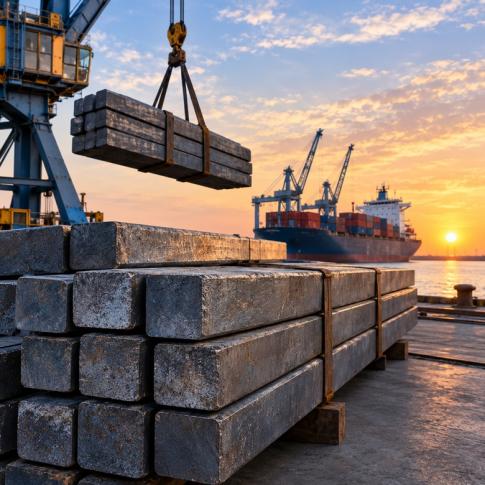
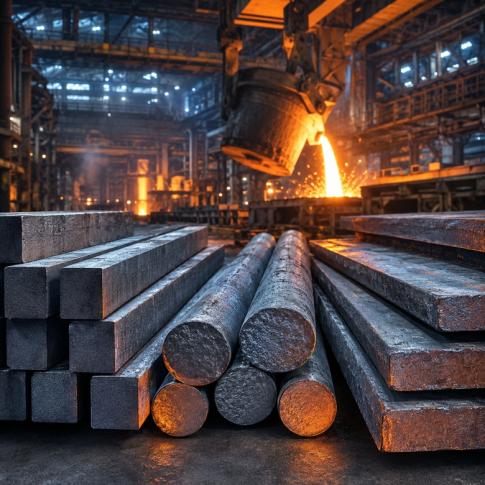
Steel billet or Steel Billet is one of the semi-finished products of the steel industry. It usually has a square or nearly square cross-section and is used to produce long steel products.
Billet can be produced through the continuous casting of molten steel and, after being cut into specified lengths, can be sent to steel product manufacturers for further rolling processes. According to the World Steel Association, billet is a semi-finished product with a square cross-section of up to approximately 155×155 millimeters, which is rolled to produce products such as wire rod, rebar, and other sections. (World Steel Association)
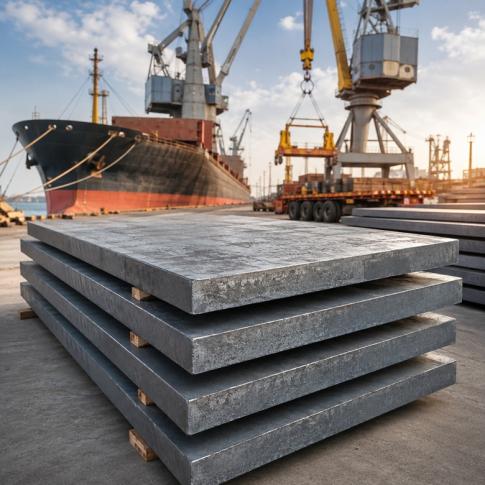
Billet differs from slab and bloom. A slab has a flat and wide cross-section and is mainly used to produce flat products such as sheets and plates, while billet is primarily used as a raw material for producing long steel products. (American Iron and Steel Institute)
Billet, slab, and bloom are all classified as semi-finished steel products, but they differ in terms of dimensions, cross-sectional shape, and applications.
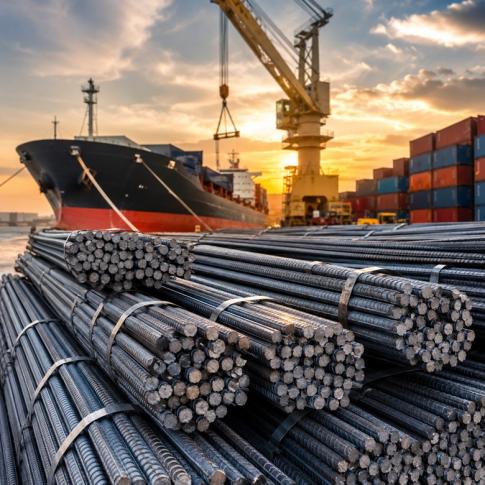
Billet: It is mainly used to produce rebar, wire rod, wire, and light steel sections.
Bloom: It usually has a larger cross-section than billet and can be used to produce heavy sections, beams, and certain long steel products.
Slab: It has a flat and wide cross-section and is used as a raw material for producing sheets, plates, and flat steel products. (steel.gov.in)
Therefore, when exporting steel billet, the dimensional and technical specifications of the product must be determined precisely according to the requirements of the buyer's plant.
Export billets can be produced in different grades and dimensions depending on the type of steel, the manufacturer, and the buyer's requirements.
Some of the most important specifications considered in billet export transactions include:
Steel grade
Chemical composition
Dimensions and cross-section
Length of each billet
Shipment weight
Carbon percentage
Manganese percentage
Silicon percentage
Phosphorus and sulfur content
Alloying elements in special grades
Surface quality
Dimensional tolerance
Production method
Production standard
Quality control test results
Certificate of Analysis and MTC
The chemical composition of billet is highly important because the final product manufactured by rolling the billet must have the required mechanical and technical properties.
Therefore, when buying export steel billet, the price per ton should not be the only decision-making criterion. The technical specifications, grade, quality, dimensions, and standard of the product must match the buyer's requirements.
The steel billet export process involves a series of commercial, technical, financial, transportation, and customs procedures.
In general, the process of exporting steel billet from Iran includes the following steps:
Identifying the target market and foreign customer
Reviewing the buyer's required technical specifications
Determining the required grade, dimensions, and volume
Checking inventory and supply capacity
Reviewing the current market price
Providing an export price quotation
Negotiating the terms of the transaction
Determining delivery terms such as FOB, CFR, or CIF
Preparing the sales contract
Supplying and preparing the steel billet
Completing customs formalities
Loading and transporting the goods
Delivering the product at the destination according to the contract
Completing financial processes and foreign exchange obligations according to applicable regulations
In large-volume transactions, checking the manufacturer's actual production capacity and ability to supply the agreed volume is highly important, as delays in billet supply can increase transportation costs or create problems for the buyer's production schedule.
The laws and regulations governing steel exports from Iran may change depending on domestic market conditions, trade policies, and decisions made by the Ministry of Industry, Mine and Trade, the Trade Promotion Organization, and Customs.
Therefore, it is not possible to consider a single fixed and permanent set of regulations for billet exports.
Before any export transaction, issues such as:
Whether the product can be exported at the time of the transaction
Regulations related to steel exports
Export duties
Export base value
Customs requirements
Foreign exchange obligations
Regulations of the destination country
should be reviewed.
It is also advisable to verify the regulations again when declaring the goods, as even a change in a single directive can affect the final cost of a large steel shipment.
One of the important issues in steel product exports is the export base value used in customs procedures.
The export base value is not necessarily the actual transaction price between the seller and the foreign buyer and may be used for customs calculations and procedures.
Therefore, when calculating the price of export steel billet, a distinction must be made between the actual transaction price, delivery terms, and the base value used for customs purposes.
Updates to the export base values of steel products can also affect export calculations. Therefore, the exporter should review the latest information related to the relevant product before declaring the goods.
Export duties are one of the most important factors affecting the cost of exporting steel billet.
The export duty rates for steel products may change over different periods. Therefore, it is not possible to state a single fixed percentage for all transactions and all periods.
As a result, before determining the final export billet price, the latest regulations and export duty schedule applicable to the tariff code and exact specifications of the product should be reviewed.
This issue is particularly important in transactions involving several thousand tons, as even a slight change in export duties can have a significant impact on the final cost of the transaction.
The price of export steel billet is not a fixed figure and depends on various factors.
The most important factors affecting the price of export billet include:
Global steel prices and market trends for semi-finished and long steel products are among the important factors determining export billet prices.
An increase or decrease in demand in global markets can directly affect the prices offered by exporters.
Billets produced in different grades do not have the same price.
General-purpose grades used to manufacture common products may have different prices compared with alloy billets or special grades.
The cross-sectional dimensions and length of the billets must match the requirements of the buyer's plant.
Therefore, the dimensions of the order are one of the details that must be specified precisely when requesting a price quotation.
The transaction volume is an important factor in export negotiations.
The price of a large shipment of several thousand tons may differ from smaller orders, and a higher volume can provide opportunities to negotiate the price, transportation, and other commercial terms.
The distance between Iran and the destination country, as well as market conditions in the destination, affect the final price.
For example, the cost of transporting a billet shipment to a neighboring country will not be the same as the cost of sending the same shipment to a more distant destination.
The price of export billet will vary depending on delivery terms such as FOB, CFR, and CIF.
Therefore, when comparing two price quotations, it must be specified which Incoterm the quoted price is based on.
Transportation is one of the major cost components of billet exports.
The high weight of steel shipments means that transportation costs can account for a significant share of the final price.
Exchange rate fluctuations also affect the export price of Iranian steel products.
Therefore, to obtain the current price of export steel billet, the product specifications, order volume, destination, and delivery terms must be specified.
The target market for billet depends on factors such as the destination country's capacity to produce long steel products, demand levels, import tariffs, transportation costs, required standards, and competitive conditions.
Since billet is a raw material for products such as rebar, wire rod, and steel sections, countries with significant rolling capacity for long steel products can be suitable markets for this product.
Some regional markets that can be considered for Iranian billet exports include:
Iraq
Turkey
Persian Gulf countries
Central Asian countries
Some Caucasus countries
Markets located near maritime transportation routes
However, the choice of export destination should be based on the actual conditions of the transaction, and high demand alone does not necessarily mean that a market is suitable.
Transportation costs, import tariffs, technical requirements, the possibility of financial settlement, and the achievable price should all be evaluated together.
Turkey is considered one of the important countries in the regional steel industry and has considerable capacity for steel production and rolling.
Therefore, the Turkish market can be one of the markets worth considering for Iranian billet exports.
However, before completing a transaction, issues such as steel import requirements, required standards, tariffs, customs conditions, transportation costs, and the competitive landscape should be reviewed.
The quality and chemical composition of the billet must also match the requirements of the buyer's plant.
Due to its geographical proximity to Iran, Iraq is one of the region's important markets for steel product trade.
One of the advantages of exporting billet to Iraq is the possibility of using land transportation on many routes, which can reduce transportation time and costs compared with some more distant destinations.
However, before shipping the goods, import conditions, customs requirements, required documents, payment methods, and regulations related to the destination country should be reviewed.
Choosing the appropriate transportation method has a direct impact on the final export price of billet.
Due to the high weight of steel products, even a relatively small difference in transportation costs can have a significant impact on large shipments.
For large shipments and more distant destinations, sea transportation is one of the main options for billet exports.
Depending on the destination and contract terms, the shipment can be transported from Iranian ports to the destination port.
In maritime transactions, determining the delivery terms and responsibility for transportation and insurance costs is highly important.
For neighboring countries such as Iraq, Turkey, and some regional markets, land transportation can be a suitable option.
The advantage of this method on certain routes is the possibility of relatively fast delivery and more direct access to the destination market.
Rail transportation can also be used on certain routes to transport steel shipments.
High transportation capacity and the ability to move large volumes of goods can make rail transportation an option worth considering for certain destinations.
The transportation method should be selected based on the destination, shipment volume, cost, delivery time, and contract terms.
The documents required for billet exports may vary depending on the destination country, contract type, and applicable regulations.
However, in a typical export transaction, documents and information such as the following are important:
Commercial Invoice
Packing List, if required
Sales Contract
Shipping Documents
Certificate of Origin
Customs documents and records
Product Certificate of Analysis
Product technical specifications
Quality control certificates
Mill Test Certificate or MTC, if requested by the buyer
Information regarding shipment weight and specifications
For industrial buyers, providing the chemical analysis and quality certificate of the billet is particularly important because the purchased product will directly enter the buyer's manufacturing process.
Billet quality is one of the most important factors in the success of exporting this product.
Before shipping the consignment, it must be confirmed that the billet has been produced and prepared according to the technical specifications agreed upon in the contract.
Some of the items that may be checked during the quality control process include:
Chemical composition
Carbon percentage
Manganese
Silicon
Phosphorus
Sulfur
Alloying elements
Cross-sectional dimensions
Billet lengths
Weight
Surface quality
Cracks and surface defects
Internal quality
Steel grade
Dimensional tolerance
Quality control test results
Since billet is rolled to produce finished products, its quality can directly affect the quality of the final product.
Therefore, the technical specifications should be clearly agreed upon between the buyer and seller before signing the contract.
Delivery terms are one of the important factors in determining the export price of billet.
Under FOB terms, the seller prepares the goods for loading onto the vessel in accordance with the applicable Incoterm, while subsequent costs and responsibilities are borne by the buyer according to the contract and Incoterm.
Under CFR terms, in addition to the obligations related to delivery of the goods, the seller pays the ocean freight to the destination port; however, insurance is not the seller's responsibility under the CFR structure.
Under CIF terms, in addition to the ocean freight, the seller also arranges the required insurance according to the applicable Incoterm.
Therefore, when comparing the prices of two export billet quotations, it must be specified whether the quoted price is based on FOB, CFR, or CIF.
In large-scale steel transactions, choosing a reliable supplier is highly important.
A billet buyer is not simply looking for the lowest price; they must also ensure that the product will be supplied according to the agreed technical specifications, in the required volume, and within the specified timeframe.
The most important advantages of working with a reliable supplier include:
Access to reputable manufacturers
Ability to supply large volumes
Review of grade and technical specifications
Product quality control
Provision of required documents and records
Transportation coordination
Handling export and customs procedures
Reducing the risk of delivery delays
Ability to provide commercial terms suited to the destination
Better coordination among the buyer, manufacturer, and transportation company
Iran is one of the important steel producers in the region. Its production capacity, access to raw materials, and favorable geographical position provide suitable conditions for exporting steel products.
Billet is also considered an important product in the steel value chain due to its widespread use in the production of long steel products.
On the other hand, Iran's proximity to markets such as Iraq, Turkey, the Persian Gulf countries, the Caucasus, and Central Asia can provide exporters with a transportation advantage.
However, billet exports, like other steel products, face intense competition among producers from different countries.
Therefore, competitive pricing, consistent quality, reliable supply, timely delivery, and valid technical documentation are important factors for success in export markets.
Steel billet exports, alongside the available opportunities, also involve a number of challenges.
Some of the most important challenges include:
Changes in export regulations
Changes in export duties
Changes in export base values
Fluctuations in global steel prices
Exchange rate fluctuations
Banking and money transfer restrictions
Increasing transportation costs
Changes in destination market conditions
Competition from producers in other countries
Potential production and energy constraints
Differences in destination country standards
Technical requirements of foreign buyers
Risk of delays in supply or transportation
Therefore, successful billet exports require simultaneous consideration of the market, production conditions, trade regulations, export costs, and the financial conditions of the transaction.
Before finalizing a billet export contract, it is advisable to review the following:
The exact technical specifications of the product should be determined.
The grade and chemical composition should match the buyer's requirements.
The dimensions and weight of each billet should be specified.
The supplier's actual supply capacity should be verified.
The current market price should be reviewed.
The latest export regulations should be verified.
Export duties and customs costs should be reviewed.
The export base value should be included in the calculations.
The transportation cost to the destination should be calculated.
Payment terms should be clearly stated in the contract.
Delivery terms such as FOB, CFR, or CIF should be specified.
Responsibility for insurance and transportation should be specified.
The technical and commercial documents required by the buyer should be determined from the beginning.
Foreign exchange repatriation requirements and obligations should be reviewed.
The risk of regulatory changes should be managed in the contract.
Tisa Tamin Trading Group, focusing on the supply of steel products and international trade activities, provides domestic and international customers with the opportunity to source and export steel products, including steel billet.
Sourcing products from reliable suppliers, reviewing technical specifications, coordinating with manufacturers, handling export procedures, and coordinating transportation are among the services that can make the billet purchasing and export process simpler and less risky for customers.
To receive information about export steel billet prices, technical specifications, available grades, minimum order quantities, payment terms, and the possibility of shipping to your desired destination, you can contact Tisa Tamin's experts.
Conclusion
Steel billet exports are one of the important sectors of Iran's trade in semi-finished steel products. As a raw material for producing long steel products such as rebar, wire, wire rod, and certain sections, billet is in demand in many industrial markets.
Iran's steel production capacity and its geographical position near regional markets have created a suitable opportunity for billet exports. However, success in this market does not depend solely on offering a low product price.
The technical specifications and grade of the billet, product quality, order volume, global steel prices, transportation costs, delivery terms, export duties, customs regulations, and destination market conditions should all be reviewed before finalizing the transaction.
In addition, given the changing nature of export regulations, duties, and customs base values, exporters should review the latest regulations related to steel product exports before each shipment.
If you are looking to buy export steel billet from Iran or export billet to international markets, choosing a reliable supplier, carefully reviewing technical specifications, calculating all export costs, and selecting the appropriate transportation method can play an important role in the success of the transaction.
Billet is a semi-finished steel product with a usually square or nearly square cross-section that is used to produce long steel products such as rebar, wire, wire rod, and certain sections. (World Steel Association)
Billet exports include identifying a buyer, determining technical specifications, checking price and availability, negotiating and signing the contract, sourcing the goods, completing customs formalities, transporting the goods, and delivering them at the destination.
The export billet price is not fixed and depends on the steel grade and chemical composition, dimensions, order volume, global steel prices, destination, transportation costs, exchange rate, and delivery terms.
Regional countries such as Iraq, Turkey, the Persian Gulf countries, some Central Asian countries, and markets located near maritime transportation routes can be considered potential markets for Iranian billet exports.
The main application of billet is the production of long steel products such as rebar, wire, wire rod, and certain steel sections. (American Iron and Steel Institute)
Depending on the destination country and type of transaction, commercial, customs, and shipping documents, a certificate of origin, commercial invoice, technical specifications, certificate of analysis, and, in many industrial transactions, an MTC are required.
Billet usually has a smaller and approximately square cross-section and is used to produce long steel products, while slab has a flat and wide cross-section and is mainly used to produce sheets and other flat steel products. (American Iron and Steel Institute)

Tisa Trading Group, with a history of more than 10 years, is one of the largest suppliers of graphite electrodes for the steelmaking industry in the country. This company, relying on foreign investment, has provided various types of graphite electrodes in the sizes required by Iranian industries.
Copyright © Tisa Tamin 2025. All rights reserved.
 فا
فا
 Ar
Ar