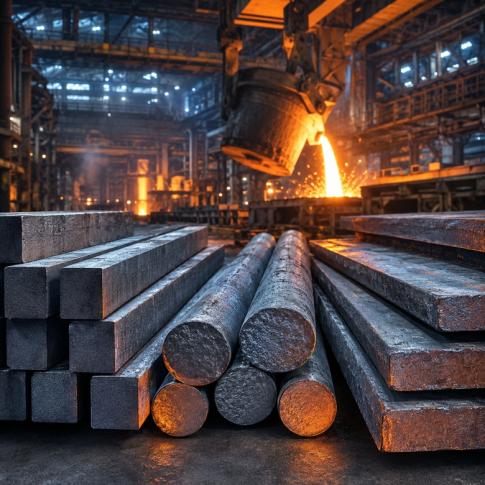
Steel ingot is one of the most important semi-finished products in the iron and steel production chain, playing a fundamental role in the production of various steel products such as rebar, I-beams, angles, channels, wire rod, and other rolled products. Therefore, steel ingot prices, supply and demand, quality and chemical composition, as well as steel ingot export conditions have a direct impact on the market for many steel products.
Steel ingot is one of the most important semi-finished products in the iron and steel production chain, playing a fundamental role in the production of various steel products such as rebar, I-beams, angles, channels, wire rod, and other rolled products. Therefore, steel ingot prices, supply and demand, quality and chemical composition, as well as steel ingot export conditions have a direct impact on the market for many steel products.
For the latest prices and steel ingot export conditions, as well as purchasing export-quality steel ingots, contact our experts.
Steel ingots are produced in various types, including billet, bloom, and slab, each serving a different market depending on its dimensions, chemical composition, production standards, and end-use applications.
On the other hand, Iran is considered one of the major producers and exporters of steel products in the region due to its abundant iron ore resources, high steel production capacity, and access to regional markets. Therefore, steel ingot buying and selling and steel ingot exports constitute an important part of the iron and steel trade.
In this post from Tisa Tamin, we examine the types of steel ingots, their applications, factors affecting their prices, buying and selling, exports, iron and steel export regulations, export duties, and the customs value of steel ingots.
Steel ingot is a semi-finished product produced through the melting and refining of steel raw materials, followed by casting. This product is used as a raw material for manufacturing a wide range of steel products.
Simply put, steel ingot is positioned in the middle of the steel production chain; it is produced after molten steel and before the material is transformed into final products such as rebar, I-beams, steel sheets, and other steel sections.
The overall steel production process can be illustrated as follows:
Iron Ore → Concentrate → Pellet → Direct Reduced Iron (DRI) → Molten Steel → Steel Ingot → Rolled Products
The quality of steel ingots has a direct impact on the quality of the final product. Therefore, when purchasing steel ingots, buyers should consider not only the price but also the chemical composition, dimensions, applicable standards, production method, and manufacturer.
Steel ingots are divided into several main categories based on their shape, dimensions, and applications. The most important types include:
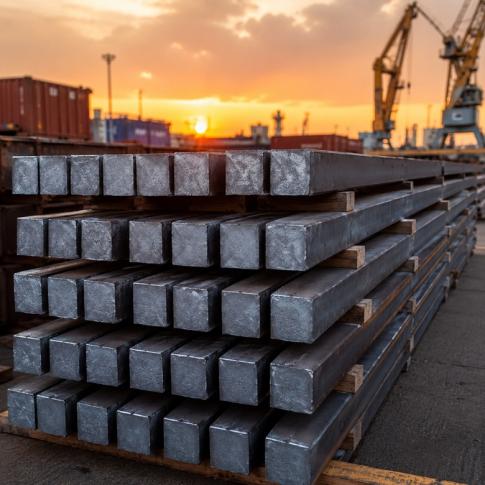
Billet is one of the most widely used types of steel semi-finished products and generally has a smaller cross-section and a longer shape.
Billet is the primary raw material used to produce products such as:
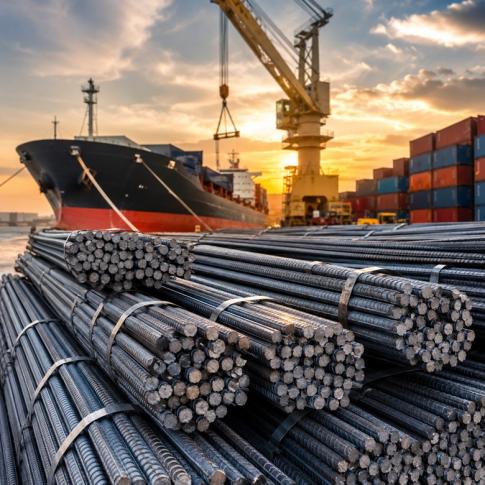
Rebar
Wire rod
Wire
Certain types of angles and channels
Light steel sections
are produced.
Therefore, billet prices are directly related to the market for rebar and other long steel products.
Follow our post on Steel Billet Export
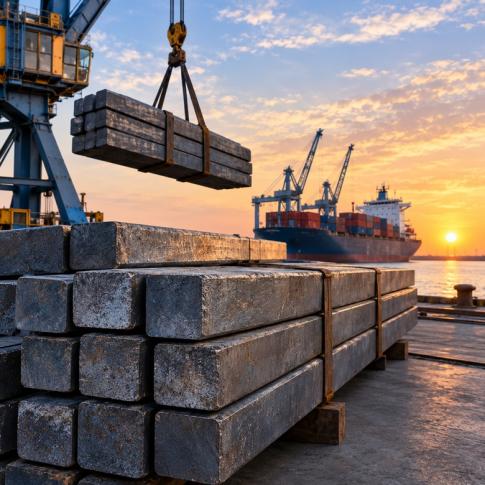
Bloom generally has larger dimensions than billet and is used to produce heavier steel sections.
Bloom can be used to manufacture products such as:
I-beams
Rails
Heavy steel sections
Certain types of pipes and industrial products
can be produced.
Follow our post on Steel Bloom Export
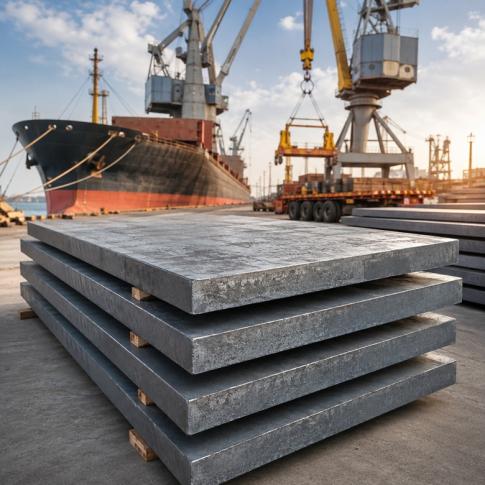
Slab, also known as a steel plate or semi-finished slab, has a wide rectangular cross-section and is mainly used to produce flat steel products.
The main products manufactured from slabs include:
Steel sheets
Hot-rolled sheets
Cold-rolled sheets
Other flat steel products
Therefore, the main difference between slab, billet, and bloom lies in their shape, dimensions, and final applications.
Follow our post on Steel Slab Export
The main differences between these three products are their dimensions, shape, applications, and the final products manufactured from them.
| Type | General Shape | Main Application |
|---|---|---|
| Billet | Small and approximately square cross-section | Rebar, wire rod, and light steel sections |
| Bloom | Larger cross-section | I-beams, rails, and heavy steel sections |
| Slab | Flat and rectangular | Production of various steel sheets |
Therefore, when purchasing steel ingots, it is important to first determine the type of rolling process and final product for which the material is required.
One of the important considerations when purchasing steel ingots is the product grade and chemical composition.
In the Iranian market, steel grades such as 3SP and 5SP are widely recognized.
The differences between these grades are related to the chemical composition and mechanical properties of the steel, and their selection should be based on the final product and the required standard.
Therefore, simply comparing the price per kilogram of steel ingot is not sufficient for purchasing, and the technical specifications of the product must also be carefully evaluated.
The chemical composition of a steel ingot indicates the amount of different elements present in the steel.
Elements such as:
Carbon
Manganese
Silicon
Sulfur
Phosphorus
can affect the mechanical properties, formability, strength, and final applications of steel.
Therefore, providing valid technical specifications and chemical analysis is highly important in bulk steel ingot transactions.
Steel ingot prices are influenced by various factors, and there is no single fixed price applicable to all transactions.
The most important factors affecting the price include:
Global steel prices and the prices of semi-finished steel products are among the important factors in determining the export price of steel ingots.
In the export market, exchange rates have a direct impact on the final price of steel ingots.
Increased demand for rebar, I-beams, and other rolled products can also increase demand for steel ingots.
The prices of iron ore, direct reduced iron (DRI), scrap, and other raw materials used in steel production also affect the production cost of steel ingots.
Steel ingots with different chemical compositions and standards may have different prices.
The manufacturer or brand, product quality, supply capacity, and delivery conditions can also affect the final price.
Transportation costs from the factory to the final destination or export border can account for a significant portion of the final price.
To answer the question “What is the price per kilogram of steel ingot?”, the date, type of ingot, grade, dimensions, manufacturer, and delivery location must be specified.
Steel ingot prices in the domestic market change on a daily basis. Export prices also depend, in addition to the base price, on factors such as exchange rates, global steel prices, destination, transportation costs, payment terms, and Incoterms.
Therefore, for bulk steel ingot purchases, it is recommended to request a quotation based on the exact product specifications and delivery conditions.
Contact our experts for the latest price quotation.
When purchasing steel ingots, price should not be the only criterion for decision-making. Before placing an order, the buyer should determine the following:
Type of ingot: billet, bloom, or slab
Steel grade
Chemical composition
Ingot dimensions
Product length
Order quantity
Manufacturer
Loading location
Destination
Payment terms
Transportation terms
Required standard
In export transactions, clearly defining delivery terms and the responsibilities for transportation and insurance costs is also extremely important.
The steel ingot buying and selling market includes both domestic and international transactions.
In domestic transactions, steel ingots may be purchased directly from the manufacturer, through suppliers, or via official trading platforms.
In export transactions, in addition to the product price, factors such as packaging, transportation, insurance, commercial documents, customs procedures, export value, payment terms, and foreign exchange repatriation also become important.
Steel ingot export is an important part of Iran's steel value chain exports.
Billets, blooms, and slabs can be exported to various markets depending on their quality, price, market conditions, and the requirements of the destination country.
Iranian steel products can be exported to regional markets and various Asian countries.
Some of the markets that have attracted attention in Iran's steel trade include:
Iraq
Afghanistan
Pakistan
Turkey
Gulf countries
Central Asian countries
However, the possibility of exporting to any particular country depends on trade conditions, the destination country's regulations, sanctions, banking restrictions, transportation costs, and import requirements.
Iron and steel exports are a broader concept than steel ingot exports and can include a wide range of products throughout the iron and steel value chain.
For example:
Steel ingots
Billets
Blooms
Slabs
Rebar
I-beams
Angles
Channels
Steel sheets
Steel coils
Other steel products and sections
Each of these products has its own tariff code, commercial conditions, and export requirements.
Therefore, iron export regulations are not necessarily the same for all products and must be evaluated based on the relevant HS code and the latest regulations.
Iron and steel exports from Iran are subject to a set of commercial, customs, and foreign exchange regulations.
Some of the most important matters that exporters should review include:
Commercial card and required permits
Commodity tariff code or HS Code
Current export regulations
Export value of the goods
Export duties
Customs requirements
Foreign exchange obligations
Commercial documents
Commercial invoice
Packing list
Certificate of origin
Shipping documents
Destination country regulations
Since export regulations may change through the issuance of new directives and circulars, exporters should review the latest regulations applicable to the relevant tariff code before conducting a transaction.
One of the most important issues for exporters is export duties on iron and steel.
Export duty rates may vary depending on the type of product and government policies. Under regulations and reports related to 2026, an export duty rate of 1% has been reported for certain products in the steel value chain, including steel ingots, billets, blooms, and slabs.
In addition, the issue of duties related to “virtual water” for exported goods has also been raised under the 2026 regulations.
Therefore, exporters should calculate and review all applicable costs and duties before pricing an export contract.
The customs value of steel ingots is an important factor in the customs declaration process.
Under customs regulations, the value of exported goods is not necessarily limited to the amount stated by the seller on the commercial invoice, and the method of determining the export value is subject to customs regulations.
According to explanations published regarding Article 16 of Iran's Customs Affairs Law, the value of exported goods is determined based on the selling price of the goods for export, plus relevant costs such as insurance, freight, and transportation up to the point of exit from the customs territory, based on the documents provided.
Therefore, accurately determining the customs value is highly important for steel ingot exports and can affect financial calculations and export obligations.
Another important issue in steel imports and exports is the correct determination of the tariff code or HS Code.
The tariff code is determined based on the exact type of product, its specifications, and customs classification, and is important for matters such as:
Customs declaration
Determining import and export regulations
Reviewing applicable duties
Determining customs value
Foreign trade statistics
Therefore, in international transactions, exporters should not act solely based on the general term “steel ingot”; the exact tariff code must be determined based on the technical specifications and applicable customs regulations.
The iron and steel export process generally begins with product sourcing and continues through to delivery at the destination.
The general process may include the following steps:
Product Inquiry → Price Evaluation → Steel Ingot or Steel Section Sourcing → Negotiation with Foreign Buyer → Commercial Agreement → Proforma Invoice → Product Preparation → Customs Clearance Procedures → International Transportation → Documentation → Delivery
The choice of transportation method is also highly important in iron and steel product exports.
Depending on the destination and order volume, transportation may be carried out by road, rail, sea, or a combination of different methods.
The price of export steel ingots is generally determined based on a combination of factors.
The most important factors include:
Global steel prices
Domestic steel ingot prices
Exchange rates
Product quality and chemical composition
Type of ingot
Order volume
Transportation costs
Distance to the border or port
Payment terms
Destination country
Export duties
Customs and port costs
Delivery terms such as FOB, CFR, or CIF
Therefore, the export price of steel ingots cannot be determined accurately without specifying the destination and transaction terms.
To obtain a competitive price in export transactions, it is recommended to first determine the order specifications accurately.
For example:
Ingot Type + Grade + Dimensions + Quantity + Manufacturer + Delivery Location + Destination + Payment Terms + Transportation Method
Once these details have been determined, the actual transaction price can be calculated.
In bulk transactions, even a difference of a few dollars per ton can have a significant impact on the final profit of the transaction.
In steel ingot buying and selling, selecting a reliable supplier is highly important because the buyer must be confident that the delivered product complies with the specifications agreed upon in the contract.
Factors such as:
Product authenticity
Valid chemical analysis
Accurate weight
Surface quality
Dimensions
Steel grade
Manufacturer
Continuous supply capability
Product documents and certificates
should be carefully evaluated before completing the transaction.
Tisa Tamin, with a focus on the supply and trading of products related to the steel industry, can assist buyers and industry professionals in sourcing steel products and conducting commercial transactions.
For purchasing steel ingots, billets, blooms, and other steel products, determining the exact product specifications and required quantity is the first step toward receiving a quotation and reviewing supply conditions.
For export transactions, specifying the destination country, order quantity, delivery terms, and product type is also important for providing an accurate quotation.
Conclusion
Steel ingot is one of the most important semi-finished products in the steel value chain, and its various types, including billet, bloom, and slab, are used to manufacture a wide range of steel products.
Steel ingot prices are influenced by factors such as global steel prices, exchange rates, supply and demand, raw material prices, product chemical composition, manufacturer, and transportation costs.
On the other hand, steel ingot exports and iron and steel exports require attention not only to product pricing but also to export regulations, tariff codes, customs value, export duties, foreign exchange obligations, commercial documents, and destination country regulations.
Therefore, for a successful transaction in the domestic or export market, simply finding the lowest price is not enough. Product quality, supplier reliability, transaction terms, additional costs, and legal requirements must also be taken into consideration.
If you are looking to buy, sell, or export steel ingots, billets, blooms, or other iron and steel products, you can provide our Tisa Tamin experts with your product specifications and required quantity so that the appropriate supply conditions and quotation can be evaluated.

Tisa Trading Group, with a history of more than 10 years, is one of the largest suppliers of graphite electrodes for the steelmaking industry in the country. This company, relying on foreign investment, has provided various types of graphite electrodes in the sizes required by Iranian industries.
Copyright © Tisa Tamin 2025. All rights reserved.
 فا
فا
 Ar
Ar